AdVocate harshit Sachar | chamber no: 617 | district courts ludhiana | 2817 gurdev nagar ludhiana | ✆+91 7889228369

The New Direction in Cheque Bounce Cases
When Procedure Starts Tilting the Scales of Justice – The New Direction in Cheque Bounce Cases
CIVIL LAWSCOMMERCIAL CASE LAWCHEQUE BOUNCE
Advocate Harshit Sachar
10/17/20252 min read
⚖️ When Procedure Starts Tilting the Scales of Justice
In cheque bounce cases under Section 138 of the Negotiable Instruments Act, the Hon’ble Supreme Court of India has recently directed the trial courts to follow a new approach — asking the accused a set of mandatory questions at the very first stage of proceedings.
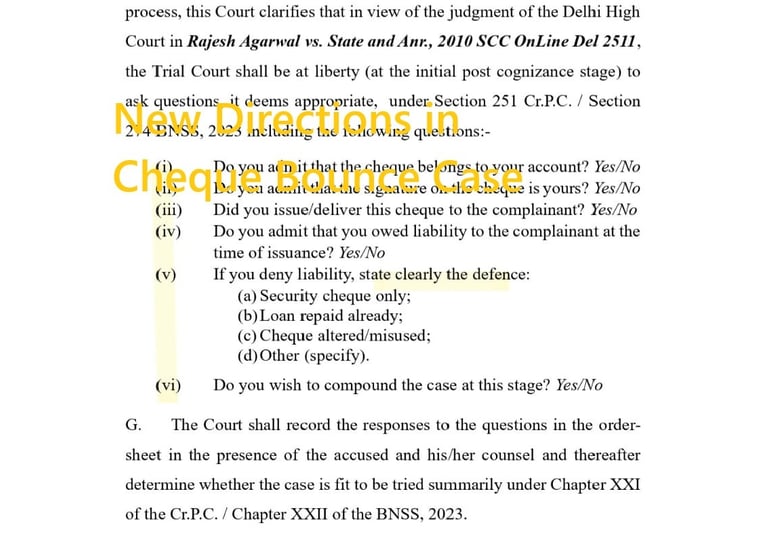
These questions, inspired by the Delhi High Court’s judgment in Rajesh Agarwal vs. State and Anr., 2010 SCC Online Del 2511, require the accused to respond on points such as:
Whether the cheque belongs to their account.
Whether the signature is admitted.
Whether the cheque was issued to the complainant.
Whether there was any legal liability at the time of issuance.
If liability is denied — the accused must clearly state the defence (such as “security cheque,” “loan repaid,” or “cheque misused”).
Whether the accused wishes to compound the matter at this stage.
These questions are now asked even before the prosecution evidence begins, during the initial post-cognizance stage under Section 251 CrPC / Section 274 BNSS, 2023.
🧩 The Intention: Speed and Efficiency
The stated purpose of these directions is to streamline cheque bounce cases — one of the most burdened areas of the criminal justice system.
By identifying undisputed facts early, courts hope to shorten trials and reduce unnecessary delays.
However, efficiency in justice must never come at the cost of fairness.
⚖️ The Concern: Fair Trial and Right to Silence
The heart of criminal jurisprudence rests on two principles:
The presumption of innocence, and
The right to remain silent.
Forcing an accused to disclose their defence at the very beginning — even before the complainant presents evidence — disturbs this balance.
It effectively gives the complainant a preview of the defence strategy, allowing the prosecution to fill any gaps in its case.
Such a move not only undermines the fairness of the trial but also dilutes the purpose of Section 313 CrPC, where the accused’s statement is meant to be recorded after prosecution evidence has been completed.
🧠 Justice or Speed?
While the intention of the courts is understandable — to ensure quick disposal of cheque dishonour cases — justice cannot be sacrificed for speed.
A fair procedure is the soul of justice.
If the process begins by compelling the accused to reveal their defence, it risks tilting the scales unfairly in favour of the prosecution.
As Advocate Harshit Sachar of Sachar Law Firm, Ludhiana, rightly observes:
“The right to silence and the burden on the prosecution to prove its case are not procedural formalities — they are the foundations of a fair legal system.”
🔍 The Way Forward
The criminal justice system must find a balance between efficiency and fairness.
Procedural reforms should simplify the process without compromising constitutional rights.
As the new BNSS framework takes shape, courts and practitioners alike must remain vigilant — ensuring that the pursuit of speed does not overshadow the pursuit of justice.