AdVocate harshit Sachar | chamber no: 617 | district courts ludhiana | 2817 gurdev nagar ludhiana | ✆+91 7889228369

Marriage Registration and Marriage Certificate in India – Complete Legal Process
Learn the complete legal process of registering a marriage and obtaining a marriage certificate in India, including documents, procedure, and importance under law.
FAMILY LAW
Advocate Harshit Sachar
11/12/20253 min read
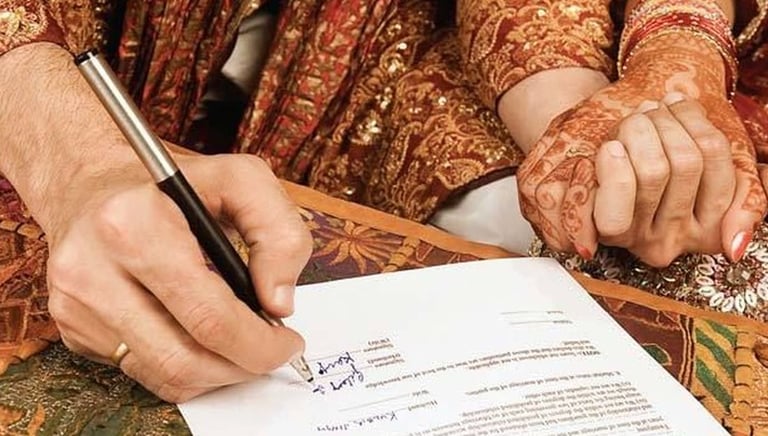
Understanding the Importance of Marriage Registration
Marriage registration is not just a legal formality — it is a vital step that provides legal recognition to a marriage.
A registered marriage certificate serves as an official proof of marriage under Indian law and is essential for several civil, legal, and social purposes, including name changes, visa applications, and inheritance rights.
In India, marriages can be registered either under:
The Hindu Marriage Act, 1955 (for Hindus, Sikhs, Buddhists, and Jains), or
The Special Marriage Act, 1954 (for inter-faith or inter-caste marriages).
The process is similar across India, though specific procedures may vary slightly from state to state. In Punjab, marriage registration is commonly done at the District Registrar Office or Sub-Divisional Magistrate (SDM) Office.
Who Can Register a Marriage
A marriage can be registered if:
The bride is 18 years or older and the groom is 21 years or older.
Both parties have consented freely to the marriage.
Neither party has a spouse living at the time of marriage.
The marriage is performed according to personal or religious customs, or solemnized before a Marriage Officer under the Special Marriage Act.
Documents Required for Marriage Registration
To apply for a marriage certificate, both spouses must submit certain documents as proof of identity, residence, and marriage solemnization. Commonly required documents include:
Application form duly signed by husband and wife.
Proof of age (Aadhaar, Passport, PAN Card, or Birth Certificate).
Proof of residence (Aadhaar, Voter ID, Electricity Bill, etc.).
Passport-sized photographs of both spouses.
Marriage invitation card or photographs of ceremony.
Affidavits confirming date and place of marriage, marital status, and nationality.
Witnesses (usually two) with valid ID proof.
For Special Marriage Act, a 30-day notice period is required before registration.
(Note: Requirements may differ slightly depending on the district or state rules.)
Procedure for Marriage Registration
The general procedure to register a marriage and obtain a certificate involves the following steps:
Submit Application:
Apply at the local Sub-Registrar Office (Marriage Registrar) within whose jurisdiction either spouse resides.
Applications can be made online or offline.Verification of Documents:
The Registrar verifies documents, witnesses, and the identity of the parties.Appearance before Registrar:
Both spouses must appear personally with witnesses for verification and signing of the register.Issuance of Marriage Certificate:
Upon successful verification, the marriage certificate is issued — usually on the same day or within a few days.
Under the Special Marriage Act, the process may take longer (30–40 days) due to the statutory notice period.
Legal Significance of a Marriage Certificate
A marriage certificate is not just proof of marriage — it carries important legal and social benefits:
Serves as proof of relationship for visa, passport, or foreign travel.
Required for joint bank accounts, insurance nominations, and property rights.
Provides legal protection in cases of matrimonial disputes or claims of maintenance.
Ensures recognition of marriage under personal and statutory laws in India.
Helps in name change and updating marital status in records.
Without a marriage certificate, couples may face difficulties proving the existence of their marriage in courts or before authorities.
Judicial Recognition and Case References
The Supreme Court of India and several High Courts have consistently emphasized the importance of marriage registration for ensuring social order and women’s protection.
Seema v. Ashwani Kumar (2006) 2 SCC 578
The Supreme Court directed all States and Union Territories to compulsorily register marriages, irrespective of religion, to prevent misuse and disputes.Lata Singh v. State of U.P. (2006) 5 SCC 475
The Court upheld the validity of inter-caste and inter-faith marriages, emphasizing the protection of couples under the Special Marriage Act, 1954.
These judgments underline that marriage registration strengthens legal protection and transparency in matrimonial relationships.
Common Legal Issues Related to Marriage Registration
Disputes regarding jurisdiction of registrar office.
Refusal to register due to religious or social opposition.
Issues of name mismatch or incomplete documentation.
Delay in issuance of certificate.
In such cases, parties can approach the District Registrar, State Marriage Officer, or even seek legal recourse in civil courts for direction to register the marriage.
Conclusion
Registering a marriage and obtaining a certificate is one of the most important legal safeguards for any couple in India.
It protects both partners’ rights, ensures social recognition, and provides a permanent legal record of the relationship.
Whether the marriage is solemnized under the Hindu Marriage Act or Special Marriage Act, timely registration prevents complications in matters of inheritance, custody, and maintenance.
For couples residing in Ludhiana and nearby regions, understanding the process helps in completing marriage registration smoothly before the District Registrar or SDM office under proper legal guidance.
“Team Sachar Law Firm, led by Advocate Harshit Sachar, provides complete assistance for marriage registration and marriage certificate services in Ludhiana.”
Disclaimer
This article is for informational purposes only and does not constitute legal advice. For case-specific guidance on marriage registration or related legal matters, you should consult a qualified advocate.