AdVocate harshit Sachar | chamber no: 617 | district courts ludhiana | 2817 gurdev nagar ludhiana | ✆+91 7889228369

How to Handle Property Disputes Among Legal Heirs
A clear legal guide explaining partition suits in India and how property disputes among legal heirs can be resolved through lawful procedures.
PROPERTY LAWSFAMILY LAWAWARENESS & COURT PROCESSES
Advocate Harshit Sachar
2/10/20262 min read
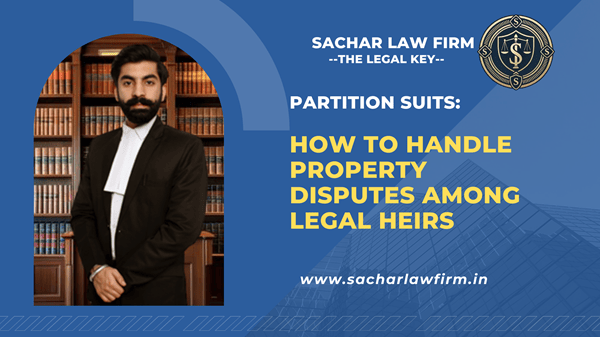
Partition Suits: How to Handle Property Disputes Among Legal Heirs
Author: Advocate Harshit Sachar
Place of Practice: Ludhiana, Punjab
Jurisdiction: India
A partition suit is a legal remedy used by co-owners or legal heirs to divide jointly owned property according to their lawful share. When disputes arise among heirs, courts can determine shares, order physical division, or direct sale of property to resolve the conflict legally.
Why Property Disputes Among Legal Heirs Arise
Property disputes among family members are common due to:
Joint ownership of ancestral property
Absence of a registered partition
Conflicting claims by siblings or relatives
Disputes over possession and use
Misinterpretation or absence of a will
Most disputes escalate because shares are never formally defined.
What Is a Partition Suit?
A partition suit is a civil case filed to:
Identify the lawful share of each heir
Separate joint ownership into individual ownership
End common possession permanently
Partition can be:
By metes and bounds (physical division), or
By sale, if division is not practical
Who Can File a Partition Suit?
A partition suit can be filed by:
Legal heirs
Co-owners
Coparceners in ancestral property
Any person holding a lawful share
Even a person in partial possession can seek partition.
Types of Property Subject to Partition
Partition suits commonly involve:
Ancestral property
Jointly purchased property
Inherited property without clear division
Family settlements not legally documented
Self-acquired property can be partitioned only if jointly owned.
Step-by-Step Legal Process of a Partition Suit
1. Filing of the Suit
The suit is filed before a civil court having jurisdiction over the property.
The plaintiff must disclose:
Ownership details
Relationship between parties
Nature of property
Relief sought
2. Determination of Shares
The court examines:
Succession laws
Family tree
Wills or settlement deeds
Revenue and title documents
Each legal heir’s share is determined legally.
3. Preliminary Decree
The court passes a preliminary decree declaring:
Who owns what share
This does not divide the property yet.
4. Final Decree & Division
After survey and valuation:
Property is physically divided, or
Sold and proceeds distributed
This stage legally ends joint ownership.
Common Mistakes Legal Heirs Should Avoid
Relying only on oral family arrangements
Allowing one heir exclusive possession for long periods
Delaying legal action
Ignoring mutation and revenue records
Delay often strengthens the party in possession.
Can Partition Be Done Without Court?
Yes. Partition can be done through:
Registered partition deed
Family settlement agreement
However, if even one heir disputes, court intervention becomes necessary.
What If One Heir Refuses Partition?
No heir can legally deny another heir their rightful share.
Courts can:
Grant injunctions
Appoint commissioners
Order partition despite resistance
Possession alone does not defeat ownership.
FAQs
Is there a limitation period for filing a partition suit?
Partition suits generally do not become time-barred as long as joint ownership continues.
Can daughters claim equal share?
Yes. Daughters have equal rights in ancestral property under Indian law.
Can partition be claimed for agricultural land?
Yes, subject to local land laws.
Is court presence mandatory for all heirs?
Not at every stage; advocates can represent parties.
Final Legal Insight
Partition suits are not about breaking families — they are about legally settling ownership to prevent future disputes. Early legal clarity saves years of litigation and preserves property value.