AdVocate harshit Sachar | chamber no: 617 | district courts ludhiana | 2817 gurdev nagar ludhiana | ✆+91 7889228369
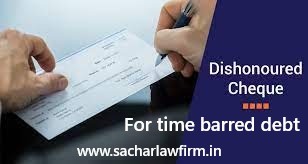
“Cheque Issued for Time-Barred Debt: Does Its Dishonour Amount to an Offence?”
Understanding whether a cheque issued towards a time-barred debt attracts criminal prosecution under Section 138 of the Negotiable Instruments Act.
CHEQUE BOUNCECIVIL LAWSCOMMERCIAL CASE LAW
Advocate Harshit Sachar, Ludhiana
10/25/20252 min read
Introduction
The Negotiable Instruments Act, 1881 was enacted to promote confidence in commercial transactions and ensure the credibility of cheque payments. Section 138 of the Act criminalises the dishonour of a cheque due to insufficient funds, treating it as a punishable offence.
However, a complex question arises — what if the cheque was issued to repay a debt that is already time-barred under the Limitation Act, 1963? Can such a dishonour still attract criminal liability?
Understanding “Time-Barred Debt”
A debt becomes time-barred when the prescribed period of limitation to legally recover it through a court of law expires — generally three years from the date when the debt becomes due. Once that period lapses, the creditor loses the right to file a civil suit to recover the amount, though the debt itself doesn’t vanish; it merely becomes unenforceable.
Cheque Issued After Limitation – Valid Promise or Void Obligation?
Section 25(3) of the Indian Contract Act, 1872 provides that a written and signed promise to pay a time-barred debt is valid and enforceable, even without fresh consideration.
Hence, if a debtor voluntarily issues a cheque acknowledging such a liability, that act revives the obligation. The cheque then represents a legally enforceable debt, meeting the condition required under Section 138.
Judicial Approach
The Supreme Court and various High Courts have examined this issue in multiple cases:
In A.V. Murthy v. B.S. Nagabasavanna (2002) 2 SCC 642, the Supreme Court observed that if a cheque is issued towards repayment of a time-barred debt, it can still constitute a valid and enforceable liability within the meaning of Section 138, depending on the facts.
Conversely, in S. Natarajan v. Sama Dharman (2014) 2 MWN (Crl) 32, the Madras High Court clarified that if the drawer disputes liability and there is no acknowledgment in writing, the presumption under Section 139 may not arise.
The consistent principle is that mere issuance of a cheque for a time-barred debt does not automatically create criminal liability unless there is evidence of acknowledgment or promise to pay.
Practical Implications
For the payee:
Always obtain a written acknowledgment or a letter from the drawer confirming that the cheque is being issued towards repayment of dues, even if time-barred.For the drawer:
Be cautious before issuing cheques for old dues — once issued, it may be treated as a fresh promise reviving liability.For courts:
Each case turns on its facts — the timing, intention, and correspondence between parties determine whether Section 138 applies.
Conclusion
A cheque issued for a time-barred debt can lead to criminal liability under Section 138, provided it amounts to a fresh promise in writing, reviving the debt under Section 25(3) of the Contract Act. Without such acknowledgment, the cheque represents a non-enforceable obligation, and its dishonour cannot attract prosecution.
Thus, both debtors and creditors must exercise caution — a simple cheque issued out of goodwill can carry significant legal implications.