AdVocate harshit Sachar | chamber no: 617 | district courts ludhiana | 2817 gurdev nagar ludhiana | ✆+91 7889228369

Breach of Trust vs Breach of Contract — Understanding the Legal Difference
While both breach of trust and breach of contract involve broken promises, the key difference lies in intention — one is civil, the other can attract criminal liability.
CRIMINAL LAWCIVIL LAWSCOMMERCIAL CASE LAW
Advocate Harshit Sachar
11/3/20252 min read
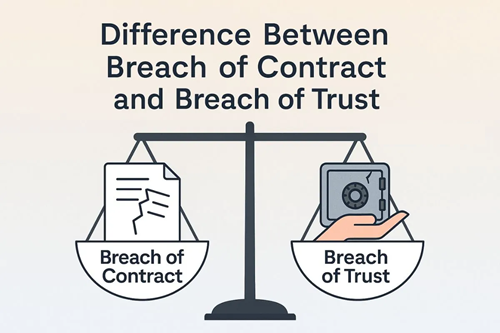
Breach of Trust vs Breach of Contract — Understanding the Legal Difference
In day-to-day dealings, disputes often arise when one party fails to fulfil an obligation. While such acts may appear similar, Indian law draws a clear distinction between breach of contract (a civil wrong) and criminal breach of trust (a criminal offence). Understanding this difference is crucial to determine the correct legal remedy and avoid misuse of law.
🔹 1. What Is a Breach of Contract?
A breach of contract occurs when one party fails to perform any term of a valid contract — whether by non-performance, delayed performance, or defective performance.
Legal provision:
Section 73 to 75 of the Indian Contract Act, 1872 deal with compensation for loss or damage caused by breach of contract.
Example:
A builder agrees to deliver a flat by June 2025 but fails to do so without a valid reason. The buyer can claim damages or refund — but this remains a civil matter, not a crime.
Nature:
Civil wrong
Based on failure to perform a promise
Remedy: damages, specific performance, injunctions
Intention is not relevant unless there is fraud or misrepresentation
🔹 2. What Is Criminal Breach of Trust?
A criminal breach of trust, defined under Section 405 of the Indian Penal Code (IPC), arises when a person entrusted with property dishonestly misappropriates or converts it to their own use, or disposes of it contrary to the legal direction.
Example:
An employee is entrusted with company funds to deposit in the bank, but he diverts the money for personal use. This amounts to criminal breach of trust, punishable under Section 406 IPC with imprisonment and fine.
Nature:
Criminal offence
Involves dishonest intention
Requires entrustment of property and misuse of that trust
Remedy: criminal prosecution, imprisonment, and fine
🔹 3. Core Legal Differences
🔹 4. Judicial Interpretation
S.W. Palanitkar v. State of Bihar (2002) 1 SCC 241
The Supreme Court held that a mere breach of contract does not give rise to criminal prosecution for cheating or breach of trust, unless there was dishonest intention from the very beginning.Indian Oil Corporation v. NEPC India Ltd. (2006) 6 SCC 736
The Court clarified that criminal law should not be used as a tool to settle civil disputes; allegations of breach of contract cannot automatically be treated as criminal breach of trust.Dalip Kaur v. Jagnar Singh (2009) 14 SCC 696
It was reiterated that entrustment and dishonest intention are the essence of criminal breach of trust. Absence of these elements keeps the matter within civil jurisdiction.
🔹 5. Practical Takeaways
If there was no dishonest intention when entering into the contract, it is a civil breach, not a crime.
A breach of trust arises only when property or money entrusted for a specific purpose is misappropriated.
Civil cases seek compensation, while criminal cases punish misconduct.
Filing a criminal case without valid grounds can backfire and attract counter-litigation.
⚖️ Conclusion
In Indian legal practice, distinguishing between civil breach of contract and criminal breach of trust ensures that justice is pursued through the proper forum. Every dispute may not amount to an offence; intention and entrustment are the key tests. Courts consistently discourage the criminalization of civil wrongs, emphasizing that justice should neither be delayed nor misused.
⚖️ Disclaimer
This article is for general informational purposes only and does not constitute legal advice. For personalized guidance, please consult a qualified advocate.